By Harrison Smith
SUNY Plattsburgh (for the Press-Republican)
An exceedingly dry summer in northern New York, with drought conditions lasting into the fall, has complicated fish conservation efforts, aquatic vegetation management and boat launch operations.
Although recent rainfall has been welcome, the National Oceanic and Atmospheric Administration reported 53% of the Northeast was affected by moderate to extreme drought as of Sept. 30. Experts are watching to see if this drought will have long-term implications.
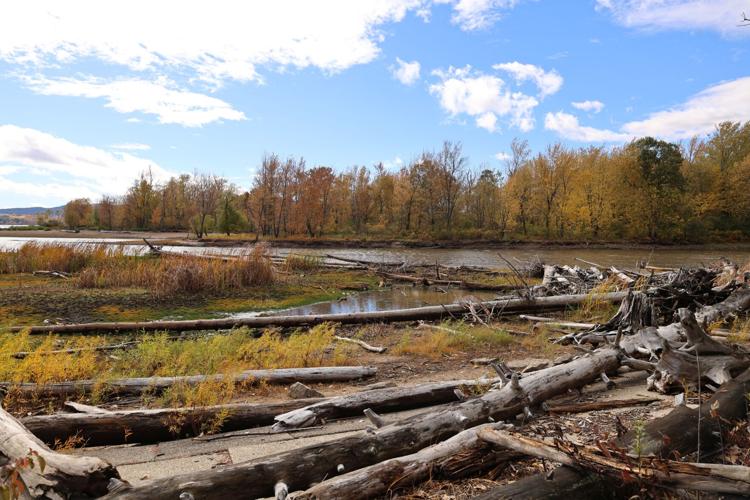
An October visit to the mouth of the Ausable River revealed a concerning discovery: The river, despite having risen since late summer, was entirely cut off from Lake Champlain, as a barrier of sand and sediment barred any fish or watercraft movement.
“We saw a large delay in landlocked salmon runs into our river systems, mostly because the delta areas where the rivers converge into Lake Champlain were so shallow and warm,“ said Jim Pinheiro, a fisheries biologist at the New York State Department of Environmental Conservation’s Region 5.
Low lake levels affect more than just mobility, Pinheiro explained.
“One of the major things that you will see this year, because the lake is so low, is the impact to aquatic vegetation growth,” Pinheiro said, explaining that a lot of aquatic vegetation grows in the shallows of Lake Champlain.
Fish species such as northern pike need this shallow aquatic vegetation to spawn, Pinheiro said. Early spring spawning could be difficult for the northern pike and other species, as the drought has left very little suitable aquatic vegetation available for this purpose.
Although a concern, Pinheiro says it’s too soon to tell exactly how the drought will impact fish in the long term. Heavier rainfall began returning later in the fall, signaling the possible return to normal water levels.
“Is that a long-term population trend impact? We can’t determine that, but it is a risk,” he said.
As low water levels threaten the growth of some aquatic vegetation, they inhibit the removal of others. Pinheiro explained that efforts to remove invasive species, such as water chestnut, in southern Lake Champlain have ground to a halt.
“Those weed harvesters had some trouble this year. Because lake levels are so low, they couldn’t navigate to the areas that they wished to control water chestnut,” he said.
While aquatic vegetation and future fish spawning tend to escape the attention of the public, issues such as waterway access require public outreach and cooperation. Pinheiro said many boaters struggled to get vessels off Lake Champlain, with some boat launches becoming unusable for larger watercraft.
“We’re actually telling folks, you know, you might have to take your boat up the lake, eight or 12 miles to the next boat ramp … in order to get it off the water,” he said.
Low water levels pose challenges, but it’s far from the only impact reduced rainfall has on environmental issues. The drought has had an impact on phosphorus levels and algal blooms in Lake Champlain, explained Sunita Halasz, a clean water community advocate for the Adirondack Council.
“In some ways, the drought is helpful because it’s not bringing new sediment from the land, but in other ways, the drought is part of the problem,” she said.
The drought has a negative impact on Lake Champlain’s phosphorus content, Halasz explained, because it impacts natural processes and creates conditions that enable existing phosphorus to produce harmful algal blooms.
“There is all of this existing phosphorus in the sediment of the lake, and things stir up the sediment … boats going over stir up the sediment,” she said.
Heavy wake boats, closer to the sedimentary layer due to low water levels, bring phosphorus out of the sediment. Above-average temperatures help this phosphorus form harmful algal blooms.
The drought has also prevented important natural processes from occurring properly.
Less rainfall, Halasz said, causes road salt to stay in the water body, as flushing is reduced. This salt creates a dense layer that prevents turnover, the natural mixing of a lake’s water column that occurs seasonally when the surface and bottom waters exchange places.
When the lake fails to turn over properly, Halasz explained, the layer of salty water loses oxygen, creating a reduced-oxygen environment. This environment facilitates a chemical reaction that releases phosphorus from the sediment, thereby increasing algal blooms.
Despite the numerous negative effects of the drought, Pinheiro shared one silver lining: low lake levels have helped raise awareness about invasive species, such as zebra mussels.
“Anybody who’s walked down to Lake Champlain this fall can see the obviously visible ring of zebra mussels around the perimeter of the lake,” he said. “If it was underwater, they didn’t see it. Now you can walk out there and physically see it, so it makes these invasive species that much more obvious.”
Pinheiro said the DEC has received an increased number of questions about zebra mussels during the drought, creating opportunities to educate concerned citizens.
Although the recent drought may seem like an unavoidable reality of an evolving climate, Pinheiro offered some ways concerned citizens can make a difference over the long term.
“The call to action is to conserve water use daily. Whether that’s, you know, not watering the lawn on the occasions that you wanted to, using methods to repurpose water as much as possible … looking at rain barrels and other types of storage systems,” he said.
Pinheiro also mentioned water-conserving shower heads and faucets as effective water-saving measures.
“Regardless of where you live along Lake Champlain, we’re all in the same watershed … we can’t make water appear, so conserving what we have is really the call to action for everyone,” he said.
How low was Lake Champlain this year? Although levels throughout late summer and fall were well below average, they weren’t record lows. However, the water levels were low enough to cause the environmental complications discussed throughout this story. The National Oceanic and Atmospheric Administration’s Burlington, Vermont, Weather Forecast Office has recorded Lake Champlain water levels since 1907, available on the Lake Champlain Extremes & Level page at weather.gov/btv/lakeLevel?year=2025.
How warm was Lake Champlain this year? Climate change and warming water temperatures go hand in hand, causing harmful impacts such as algal blooms. It seems like Lake Champlain’s water has been warmer than usual this summer and fall, but how does it really compare to historical trends? The National Oceanic and Atmospheric Administration’s Burlington, Vermont Weather Forecast Office maintains a Lake Champlain Extremes & Temperature page, weather.gov/btv/lakeTemp?year=2025, which has been recorded since 1972. This graph reveals that higher-than-average temperatures have been recorded throughout the summer and fall of 2025, including a couple of record-high days. Despite this trend, the overall temperature is well below the warmest on record.