Journalism and media programs across SUNY campuses have seen some favorable energy of late. Here are some recent changes to recognize:
At Oswego, a new media mega building
The new Hewitt Hall is open after having received $80 million in renovations that staff touts will make it one of the best buildings in the nation for media.
Fully funded by the SUNY Construction Fund, the upgrades prepare students for dynamic careers in media, journalism, filmmaking, design and communication –- and all kinds of overlapping and interrelated fields.
“People in their careers, they don’t do just one thing,” said Jennifer Knapp, dean of the College of Communication, Media and the Arts. “They need to be very diverse with their skillset. We want people to be experts in their chosen field but we also know that it’s important for them to be conversant in adjacent fields.”
At Oneonta, OnNY is their new media center
In September, the university unveiled its new OnNY Community Media Lab, an on-campus state-of-the-art newsroom where students will learn to edit and produce multimedia stories, just like working journalists.
A summer-long renovation transformed the ordinary classroom into a colorful, modern multimedia space where students can conduct interviews, brainstorm story ideas at collaborative working spaces, research and type their stories at computer workstations, all while keeping an eye on developing world news on the surrounding large mounted televisions.
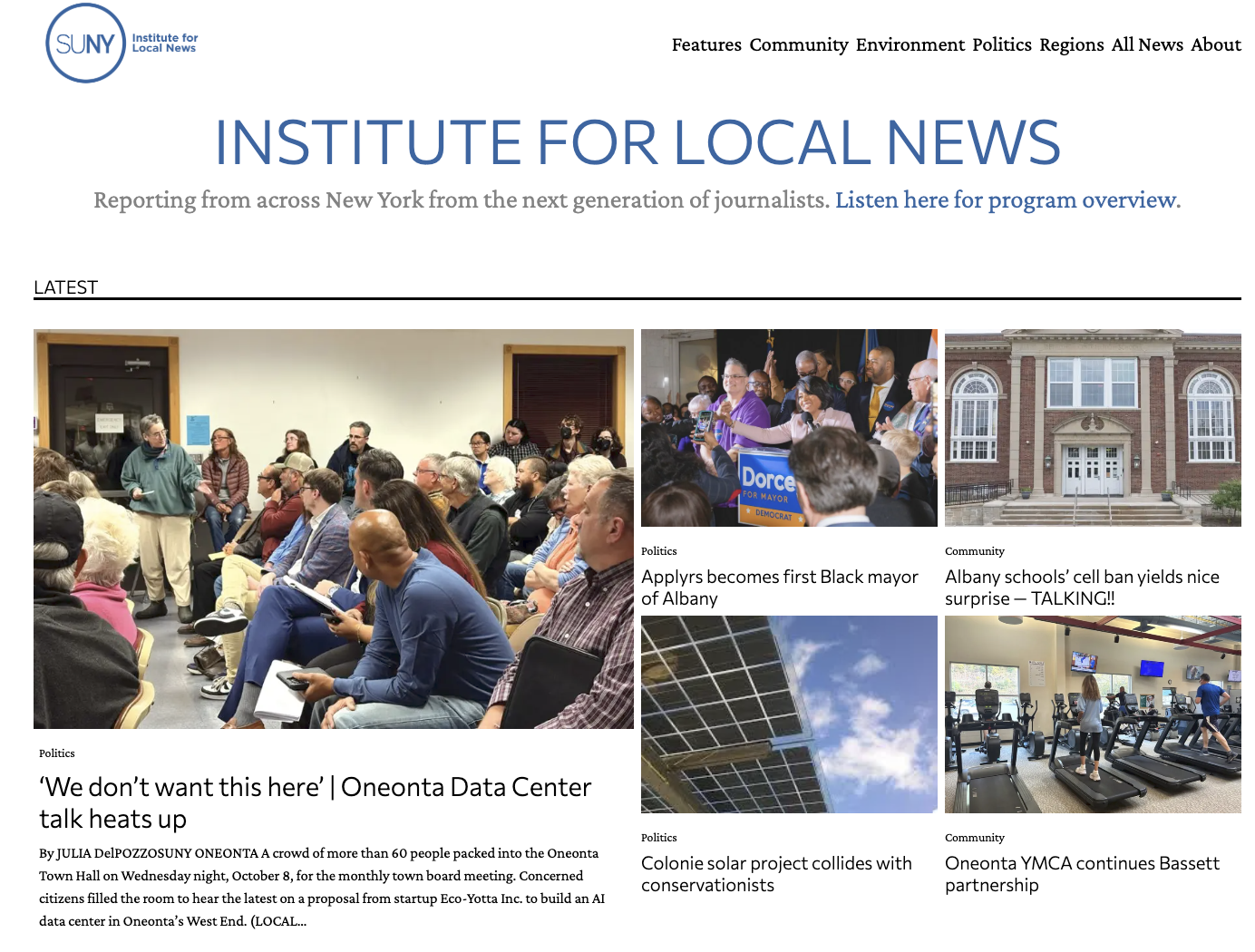
The lab will also serve as the home base for SUNY Oneonta’s iteration of the SUNY Institute for Local News, a State University of New York initiative that lets students work with area media outlets to produce news content while developing experience and a portfolio of work.
At Stony Brook, Journalism becomes its own department due to growth
In the summer of 2025, the School of Communication and Journalism at Stony Brook University reached an important milestone: its Communication and Journalism programs officially became two distinct academic departments. Each department now has its own chair: E.K. Tan, associate professor, leads the Department of Communication, and Margaret Schedel, professor, leads the Department of Journalism. The school is led by Dean Stephanie Kelton, who began her tenure on September 8, 2025.
The shift from academic programs to full departments reflects the continued growth of the school’s student body and faculty. Preliminary Fall 2025 numbers show the school enrolling a combined 360 undergraduate and graduate students, another year of record growth. This represents nearly 9% growth since Fall 2023 and continued year-to-year gains through Fall 2025.
The rise in enrollment aligns with growing academic demand, a trend reflected in the school’s student credit hours. In Fall 2025, the School of Communication and Journalism generated 6,186 credit hours, positioning SoCJ among the university’s growing academic units. These increases point to expanding visibility and interest in communication and journalism degrees at Stony Brook.
The creation of two academic departments provides a structure that aligns with SoCJ’s overall growth. The new departmental model supports continued development of the curriculum, faculty engagement, and student pathways as enrollment and interest increases across the school.
At Brockport, a new honors class in reporting
A cross-section of majors from across campus are enjoying a chance at local reporting for credit.
Last Fall, Professor Kim Young partnered with the Honors College to start a Community Journalism course. Five Honors College students have taken the course.
Adapting as they go — the school has recently dropped the prerequisite for the course, which has created new interest from a wide swath of majors. The course counts as a liberal arts credit which, in addition to the lack of a prerequisite, is appealing to a cross-section of majors.
At University of Buffalo, a Community News class starts
As described in the school guide, the new Community News Reporting course “connects student writers to the local Buffalo news landscape, providing students a platform for writing and publication that supports the needs of local news outlets. This course provides writers the opportunity to amplify the diverse voices and stories of the Buffalo area.”
It has started out with 6 students who are in story partnership with local publishers, The Amherst Bee and The Buffalo Hive.
Professor Jay Barber created the course after being part of the SUNY Institute for Local News and its mission to enhance student learning through local news reporting opportunities.
“It has been exciting to see the way the students get excited about assignments that connect them to the local community,” said Jay Barber. “They have all been to town meetings in the Buffalo suburbs and are now researching cultural events in Buffalo. Editors from our two news partners have visited our classes, helping students see the “face” of the publications they are writing for.”
The class will be next up in fall 2026.
At New Paltz, the Legislative Gazette reboots
The Legislative Gazette has been a New Paltz program for decades creating robust statehouse coverage. The new director is Darren Johnson and he announced ALL SUNY students can work at the Gazette for 1-12 credits through Open SUNY.
They will learn how to work for and operate a newspaper based in the Capitol. He is looking for all student types: journalists, primarily, but also design, digital media and business majors.